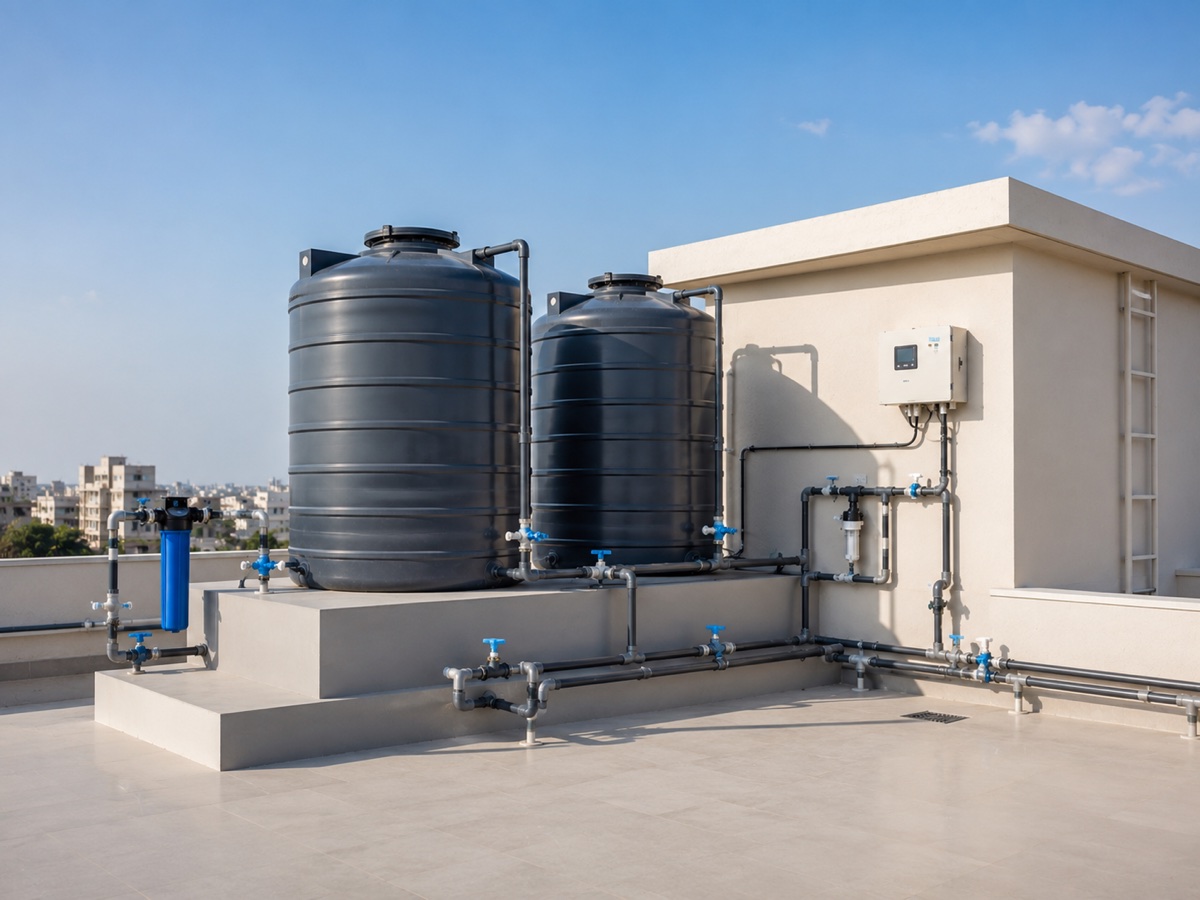
Every building with an overhead tank or sump in India runs into the same problem: someone has to guess when the tank is low, switch the motor on, and remember to switch it off before it overflows. Get it wrong and you either run dry mid-shower or waste hundreds of litres down the overflow pipe. Water tank automation solves this with two pieces of hardware and one dashboard — this guide covers exactly how it works and what it costs.
What is water tank automation?
Water tank automation is a system of sensors and controllers that monitors tank water level in real time and automatically switches the motor pump on and off — without anyone checking the tank manually. A basic system has three parts:
- A level sensor — usually ultrasonic, mounted on top of the tank, measuring water level every 30 seconds with no moving parts to wear out.
- A motor controller (relay) — wired into the electrical panel, turns the pump on when the tank drops below a threshold and off when it’s full.
- A dashboard or app — shows live tank level, motor status, and alerts, accessible from a phone.
How does the sensor measure water level?
Modern systems use ultrasonic sensors rather than mechanical floats. An ultrasonic sensor sits above the water surface and sends a sound pulse downward, measuring the time it takes to bounce back to calculate distance — and therefore water level — as a percentage. Because there’s no float, no float arm, and no contact with the water, there’s nothing to corrode, jam, or need replacing. Accuracy is typically within ±2% of tank capacity.
How does automatic motor control work?
The motor controller is a relay wired in-line with the pump’s power supply. It receives the tank level reading and applies simple logic: below a low threshold (commonly 20-30%), turn the motor on; at a high threshold (commonly 90-100%), turn it off. This single change eliminates the two most common failure modes in manually-operated systems — motors left running for hours after the tank is full (wasted electricity, shortened motor life) and tanks running completely dry (no water when residents need it).
Good systems also protect the motor itself: cutting power if the tank is empty for an extended period prevents dry-running, which is one of the fastest ways to burn out a pump motor.
What does it cost?
Pricing depends heavily on whether you’re buying hardware outright or subscribing to a managed service:
- One-time purchase (homes): A sensor-only kit runs roughly ₹9,000; a sensor + motor controller bundle roughly ₹13,000, plus installation.
- Subscription (buildings/societies): For multi-tank properties, most providers now offer a per-node monthly subscription instead of upfront hardware cost — the provider owns and maintains the hardware, you pay monthly, and the price is typically set per sensor/controller unit (“node”) rather than per building.
For a housing society, the honest comparison isn’t the sensor cost — it’s against what you’re already paying. Most mid-sized societies employ a pump operator at ₹15,000-25,000/month specifically to run the manual routine this system replaces. A subscription-based automation system commonly costs less than half that, while adding 24/7 monitoring a human operator can’t provide overnight.
Does it work with existing motors and tanks?
Yes, generally. Ultrasonic sensors work with any tank shape or material — no retrofitting needed on the tank itself. Motor controllers support both single-phase (most residential/small society pumps) and three-phase (larger borewell or commercial pumps) setups. Installation typically requires a licensed electrician and takes about an hour per tank once the crew is trained on the system.
What happens if WiFi or the network drops?
This is worth checking before buying — a poorly designed system loses its core function (motor automation) the moment connectivity drops. Well-designed systems separate the two: motor on/off logic runs locally on the device itself, independent of any network connection, while only remote monitoring (viewing the level on your phone) depends on connectivity. Multi-tank building systems typically use a mesh protocol like LoRa between sensors and a single site gateway, rather than requiring WiFi at every tank — this is both more reliable and easier to install across a large property.
Is it worth it for a single home vs a whole building?
For a single home, the case is convenience and modest electricity/water savings — worthwhile if you’re tired of manual checking, but the payback period is longer. For a society, hospital, hotel, or commercial building with multiple tanks and a dedicated staff member currently doing this manually, the economics are direct: automation typically costs less than the labour it replaces, on top of eliminating overflow complaints and dry-tap incidents that a human on an 8-hour shift can’t fully prevent.
Frequently asked questions
Do I need to replace my existing motor?
No. The controller wires into the existing motor’s power supply — it doesn’t replace the pump itself.
How long does installation take?
Roughly an hour per tank for a licensed electrician, plus a one-time gateway setup for multi-tank sites.
Can I start with monitoring only and add motor automation later?
Yes — most modular systems let you deploy sensor-only nodes first and add the motor relay to any node later without reinstalling anything.
