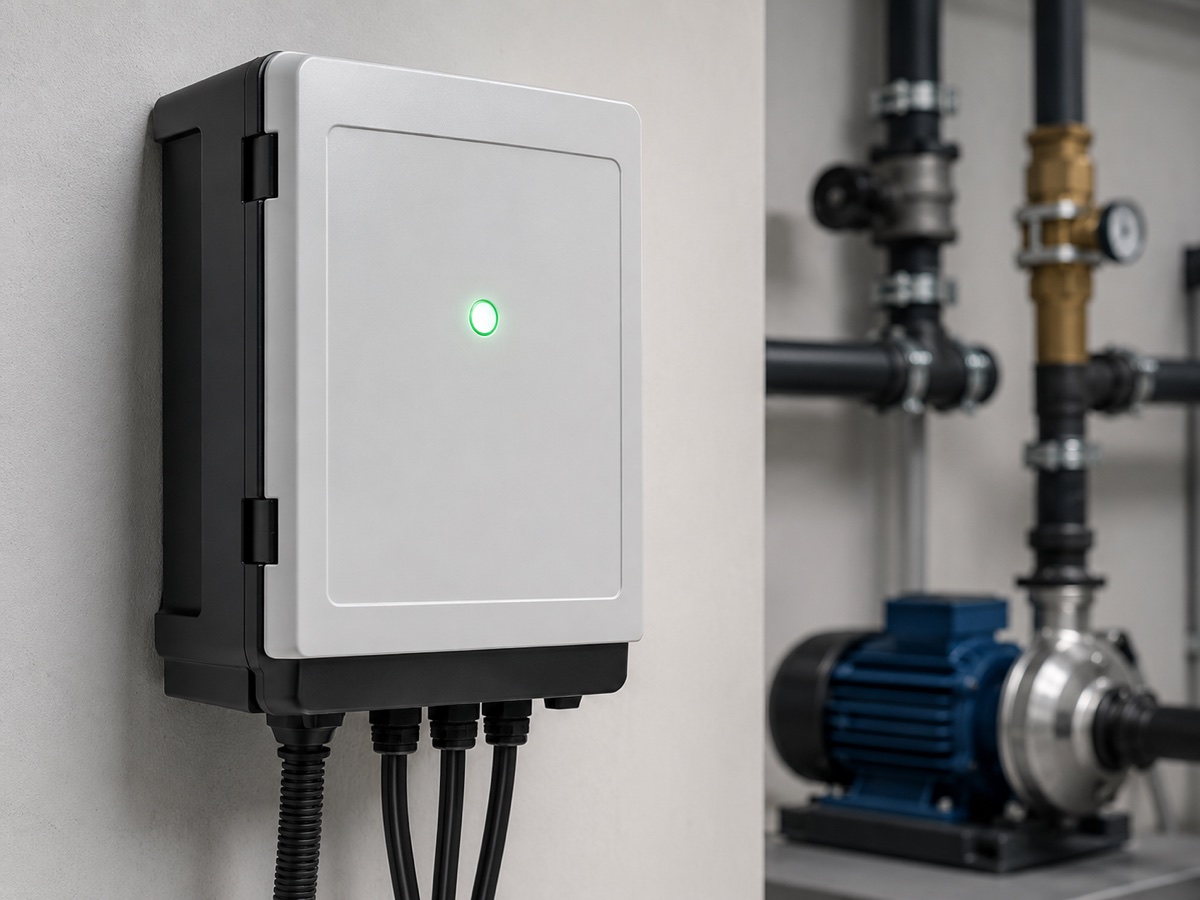
Basic tank automation answers one question: is the tank full or empty. Predictive pump maintenance answers a different, arguably more valuable question: is this pump about to fail, and why. The difference matters because pump failure is expensive and disruptive in a way that a slightly-late tank refill isn’t — a burned-out motor means an emergency callout, a replacement cost, and water downtime while it’s being fixed.
What actually causes premature pump failure
A handful of failure modes account for most premature pump deaths, and they’re mostly preventable if caught early:
- Dry-running — the pump runs with no water to move, which removes the cooling and lubrication the water itself normally provides. This is one of the fastest ways to burn out a motor, and it happens more often than most facility teams realize, usually from a sensor failure or a source running out unexpectedly.
- Cavitation — air bubbles forming and collapsing inside the pump due to pressure drops, which physically erodes internal components over time.
- Bearing wear — mechanical wear that builds up gradually over weeks or months, eventually causing the motor to seize.
- Excessive cycling — a motor switching on and off too frequently (short cycling) stresses the motor with repeated inrush current, shortening its life even if each individual run is otherwise normal.
Traditionally, none of these are caught until the pump actually fails — there’s no visibility into any of them from a simple on/off tank controller.
What sensors actually make prediction possible
Predictive maintenance isn’t guesswork — it’s built on specific sensor signals that carry real information about pump condition, mainly:
Vibration (piezo sensors)
A piezoelectric sensor mounted on or near the pump picks up vibration patterns. Different failure modes have distinct vibration signatures: dry-running produces an immediate, sharp change (water normally dampens vibration, so its absence shows up clearly and fast); cavitation shows up as high-frequency noise; bearing wear shows up as a low-frequency rumble that gradually increases in amplitude over weeks. This is the same underlying principle used in industrial predictive maintenance for large machinery, applied to a much smaller and cheaper sensor package for water pumps.
Current draw
A pump’s electrical current draw changes with mechanical load. A blocked impeller shows up as a current spike; a failing motor often shows up as unusual current patterns before it fails completely. Current sensing is a strong complement to vibration — together, the two give a more reliable picture than either alone (this combination is specifically effective at eliminating false positives on dry-run detection, since both signals have to agree).
Tank level correlation
Combining level data with vibration and current gives context vibration alone can’t — for example, confirming dry-run isn’t just “vibration changed” but “vibration changed AND the tank level shows there’s no water to pump.”
From raw signals to a health score
Raw sensor data isn’t useful to a facility manager on its own — nobody wants to interpret a vibration frequency graph. The point of a pump health score is translating these signals into something actionable: a single 0-100 score, updated regularly, that reflects overall pump condition. A score trending downward over weeks is the signal to schedule maintenance proactively, rather than waiting for an outright failure.
This is meaningfully different from a simple alert system that only fires when something’s already gone wrong — a health score captures gradual degradation (like slowly worsening bearing wear) that wouldn’t trigger any single threshold-based alert until it’s already a serious problem.
What this looks like in practice
Instead of “pump failed, emergency callout needed,” predictive maintenance produces something like: “Pump 3 at Block B is showing early bearing wear signs — service recommended within 3 weeks.” That’s the practical value: converting an unplanned, expensive emergency into a planned, cheaper maintenance visit, scheduled on your terms rather than the pump’s.
For a property managing multiple pumps — a society with several towers, a hotel with multiple pressure zones — this also enables fleet-level prioritization: seeing which of many pumps needs attention first, rather than treating every pump as equally at-risk with no data to differentiate them.
What this doesn’t replace
Predictive maintenance reduces the frequency of surprise failures — it doesn’t eliminate the need for maintenance entirely, and it can’t predict genuinely sudden mechanical failures with no gradual warning signature (a manufacturing defect, for instance). It’s a meaningful improvement over “wait until it breaks,” not a guarantee against every possible failure mode.
Frequently asked questions
Does this require extra hardware beyond a standard tank sensor?
Vibration-based pump health monitoring needs a vibration (piezo) sensor and ideally current sensing near the motor — this is separate from the tank level sensor, though it can be part of the same node/controller hardware rather than a fully separate system.
How long before a new installation has enough data to give useful predictions?
Some failure modes (dry-run, cavitation) can be detected immediately since they have distinct, well-understood signatures. Others, like bearing wear trends, benefit from a baseline period — typically a few weeks of normal operation — before deviations become clearly meaningful.
Is this only relevant for large commercial pumps, or does it help home setups too?
The principle applies at any scale, but the economics favor larger/commercial setups more clearly — a home motor replacement is a few thousand rupees; a large commercial pump failure, plus the water downtime while it’s fixed, is a much bigger cost that predictive maintenance more clearly justifies preventing.
