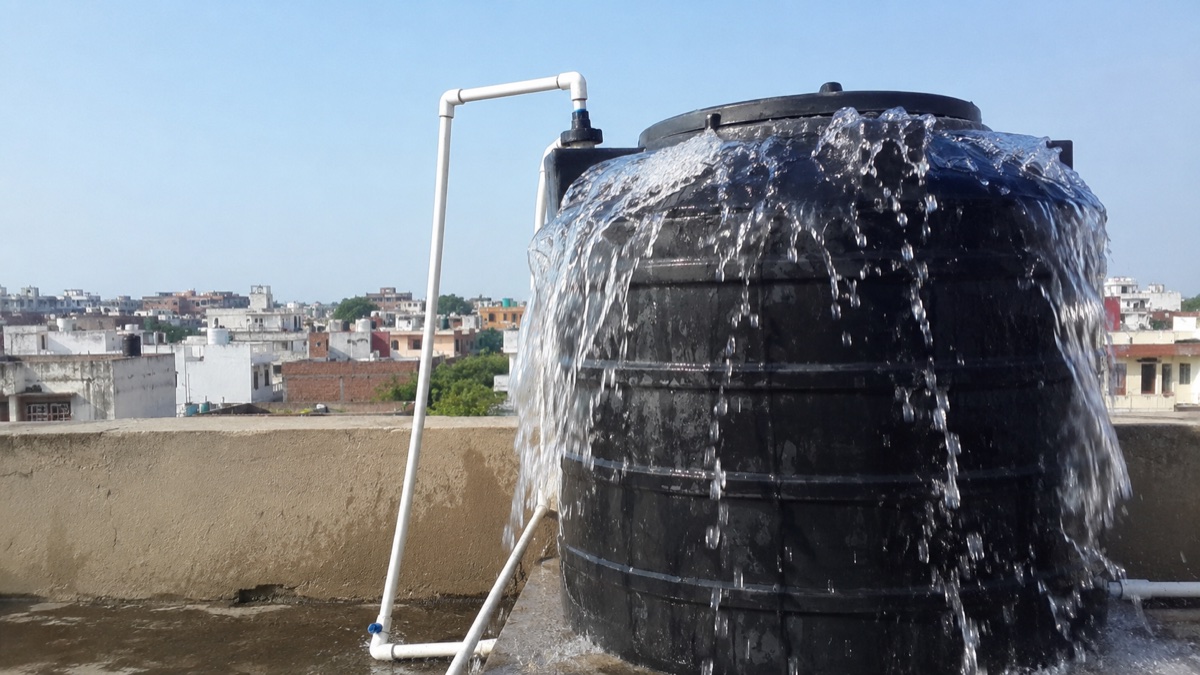
If you have a float valve and your tank is still overflowing, you’re not imagining it — float valves are genuinely one of the most common points of failure in Indian water systems, and the failure is almost always silent. You don’t get a warning. You get a flooded terrace, hundreds of litres wasted, or a soaked ceiling if the overflow pipe can’t keep up.
How a float valve is supposed to work
A float valve (also called a ball valve or float-cum-valve) uses a floating ball connected to an arm, which mechanically opens or closes a water inlet valve as the water level rises and falls. As the tank fills, the float rises, and at a set height the arm closes the valve, stopping inflow. It’s a purely mechanical system — no electricity, no sensor, no app. That’s its main appeal: it’s simple and cheap.
It’s also exactly why it fails the way it does.
The actual failure modes
1. The float arm gets stuck
Over months of use, the arm’s pivot point accumulates dirt, mineral deposits (especially with hard water), or corrosion. It stops moving freely. If it sticks in the “open” position, water keeps flowing even after the tank is full — this is the single most common cause of tank overflow in Indian homes.
2. The float itself develops a leak
Floats are usually hollow plastic or metal spheres. Over years of sun exposure (rooftop tanks) and temperature cycling, they can crack and slowly fill with water. A partially-waterlogged float doesn’t rise as high as it should, so the valve never fully closes — a slow, constant overflow that’s easy to miss because it looks like a “small leak” rather than a stuck valve.
3. Mineral buildup on the valve seat
Hard water (common in much of India) leaves mineral deposits on the valve seat itself. Even with a perfectly functional float, if the seat doesn’t seal cleanly anymore, water seeps through continuously.
4. Wrong valve for your water pressure
Float valves are rated for specific pressure ranges. If your municipal or pump pressure is higher than the valve is rated for, it may not seal properly even when new, leading to a persistent trickle that eventually becomes a real overflow.
Why these failures are so hard to catch
A float valve gives you no feedback. There’s no alert, no log, no indication anything’s wrong until you either see the overflow directly or notice the water bill/electricity bill creeping up from a motor that’s now compensating for constant loss. Most people only discover a stuck float when the damage is already done — water stains on a ceiling, a flooded terrace, or a spike in the monthly water tanker order.
Maintenance can extend float valve life — but doesn’t eliminate the risk
Regular cleaning of the float arm pivot and valve seat (every few months) reduces failure frequency, but doesn’t eliminate the core problem: a mechanical system with no way to alert you when it’s already failing. Even a well-maintained float valve is one stuck pivot away from an unnoticed overflow.
What an ultrasonic sensor changes
An ultrasonic level sensor has no moving parts in contact with water — nothing to stick, corrode, or crack. It measures water level continuously (typically every 30 seconds) and reports it, rather than mechanically reacting to it. Paired with a motor controller, the same on/off automation happens, but with two real advantages a float valve can’t offer:
- You see the actual level, not just a binary open/closed state — so a slowly rising baseline (a sign something’s off) is visible before it becomes an overflow.
- Alerts fire before the failure becomes physical damage — if a tank hits an unusually high level outside its normal fill pattern, the system can flag it immediately instead of relying on someone noticing water on the floor.
When is it worth upgrading?
If you’ve had even one overflow incident traceable to a stuck or leaking float, that’s usually the signal — it means the mechanical failure mode has already happened once and will happen again, since the underlying wear (corrosion, mineral buildup) doesn’t reverse itself. For a single home with no history of overflow, a well-maintained float valve is a reasonable, low-cost choice. For a building with multiple tanks, or anywhere overflow means real cost (wasted municipal supply, water damage, tanker charges), the case for sensor-based monitoring is stronger — the visibility alone, even before automation, catches problems a float valve physically cannot.
Frequently asked questions
Can I just replace the float valve with a new one instead of switching systems entirely?
Yes, and for a single home with no other issues, a fresh float valve (₹200-500) is the cheapest fix. It doesn’t solve the underlying problem that failures are silent — you’ll be back here again in a year or two.
Does hard water make float valves fail faster?
Yes — mineral deposits (scale) build up on both the pivot mechanism and the valve seat faster in hard water areas, shortening the reliable lifespan meaningfully compared to soft water regions.
Do I need to remove the float valve if I install a sensor-based system?
Not necessarily as a backup safety measure, but the sensor-based motor controller becomes the primary control — you generally wouldn’t rely on both simultaneously for the same tank, since they can work against each other if their thresholds don’t match.
