Search for an automatic water level controller in India and you’ll find dozens of options — from ₹500 DIY float-switch kits to ₹15,000+ smart systems with apps. Most listings compete on price and vague claims like “smart” or “advanced.” Here’s what actually differs between them, and which differences are worth paying for.
Float switch vs ultrasonic sensor
This is the single biggest quality difference, and it’s often not stated clearly in product listings.
- Float switch: A mechanical float rises and falls with water level, triggering a switch at set points. Cheapest option. Failure mode: the float arm gets stuck, corrodes, or gets tangled — when it fails, it usually fails silently, and you don’t find out until the tank overflows or runs dry.
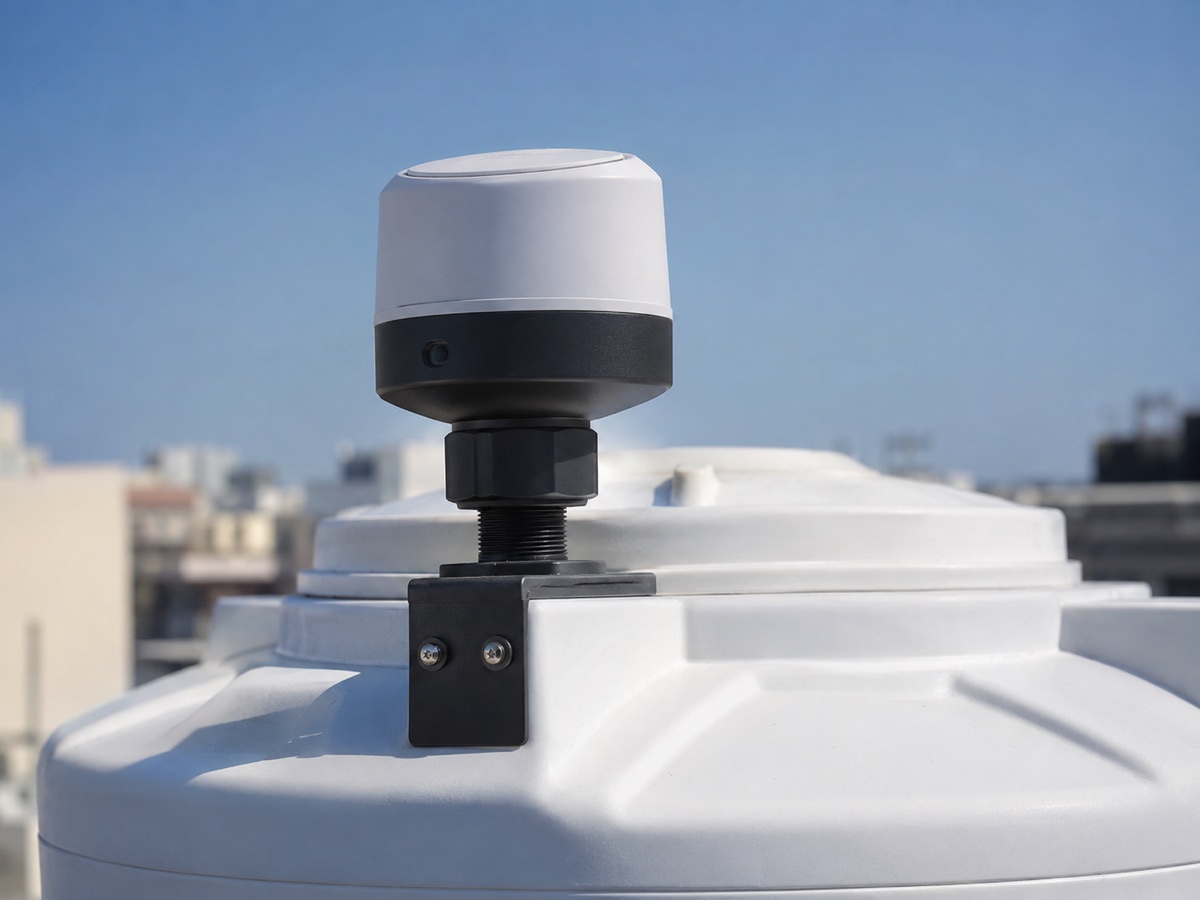
- Ultrasonic sensor: Measures distance to the water surface using sound pulses — no contact with water, no moving parts. More expensive, but nothing to mechanically wear out. Also gives you an actual percentage reading (73% full) instead of just high/low/empty signals.
If you just want basic auto on/off with no visibility into the actual level, a float switch works and costs less. If you want to actually see your tank level on a phone, or you’ve been burned by a float sticking before, ultrasonic is the meaningful upgrade.
WiFi vs LoRa — matters more than it sounds
For a single home with one tank, this barely matters — WiFi is simpler to set up. It starts mattering the moment you have more than one tank, or a tank that’s far from your router (terrace tanks are notorious for weak WiFi).
LoRa-based systems use a separate long-range radio protocol between the sensor and a central gateway, rather than connecting each sensor to WiFi directly. One gateway can cover an entire building or even a small campus, and individual sensors don’t need to be anywhere near a router. For societies, hotels, schools — anywhere with multiple tanks — this is the difference between “one WiFi setup per tank” and “one gateway, done.”
One-time purchase vs subscription
Two different pricing models exist and they suit different buyers:
- One-time purchase (typically ₹9,000-15,000): You own the hardware outright. Common for single homes. Watch for what happens after the warranty — is there a paid AMC, or are you on your own if something breaks in year 3?
- Subscription (commonly priced per sensor/controller per month): The provider owns and maintains the hardware — repairs, replacements, and firmware updates are included in the monthly fee, no separate AMC. No upfront cost. This model is increasingly common for buildings with multiple tanks, where the economics work out cheaper than a dedicated pump operator’s salary.
Neither is objectively better — it depends on whether you’d rather pay once and own it, or pay monthly and never worry about hardware failure or firmware updates yourself.
Does it actually stop dry-running, or just tell you the tank is low?
Some “smart” controllers just alert you when the tank is low — you still have to act. A real dry-run protection feature cuts power to the motor automatically when the tank has been empty too long, which is what actually prevents motor burnout, not just an alert you might miss.
Single-phase vs three-phase motor support
Most homes run single-phase motors. Larger borewell setups, and most commercial/society installations, run three-phase. Confirm compatibility before buying — retrofitting a controller built only for single-phase onto a three-phase motor isn’t a simple swap.
Water quality — the feature most listings don’t mention at all
A handful of systems also measure TDS (total dissolved solids) — giving a daily water safety score and contamination alerts, not just level. This is genuinely rare in the Indian market; most controllers only ever talk about level and motor control. If water quality matters to you (drinking water safety, hard-water damage to appliances), it’s worth specifically asking whether a system includes this, since it’s usually not advertised prominently.
For a single home vs a building with multiple tanks
The comparison changes depending on scale:
- Single home, one tank: Float vs ultrasonic and one-time-purchase price are the main decisions. LoRa vs WiFi barely matters.
- Society, hotel, hospital, school — multiple tanks: LoRa/gateway architecture, subscription pricing, and fleet-level dashboards (seeing every tank on one screen) become the real differentiators. A system designed for single homes usually doesn’t scale cleanly to 10+ tanks without becoming 10 separate WiFi setups to manage.
Frequently asked questions
Is a more expensive controller always better?
Not necessarily — for a single home with one tank near a router, a simpler WiFi-based ultrasonic system covers most of what matters. The higher-end features (LoRa gateways, fleet dashboards, TDS monitoring) earn their cost at multi-tank scale.
Can I upgrade from monitoring-only to full motor automation later?
With modular systems, yes — sensor-only nodes can usually have motor control added later without replacing the sensor. Worth confirming this explicitly before buying if you’re starting with monitoring only.
What’s the real installation time?
For a single tank with a trained electrician: roughly 30-60 minutes. Multi-tank sites add a one-time gateway setup step, but each additional tank is still roughly the same per-tank time.
