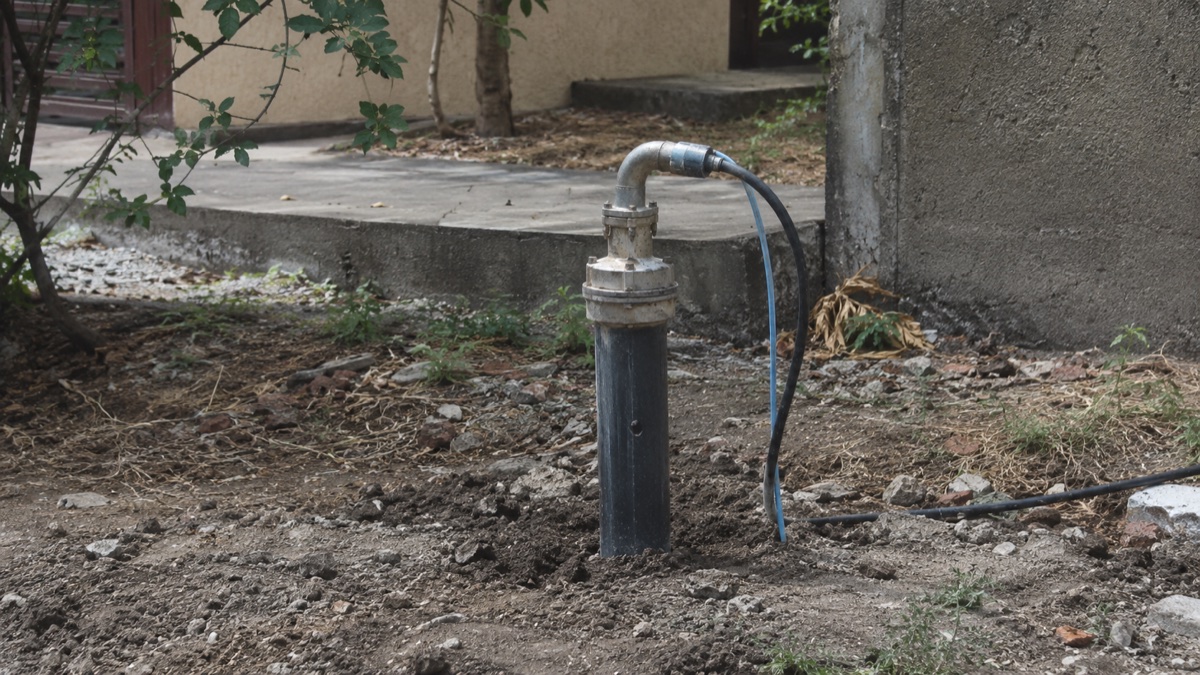
Borewells don’t usually fail suddenly. What actually happens is a slow decline in yield — the bore delivers a little less each week — until one hot afternoon it can’t keep up with demand and the taps run dry. The frustrating part is that the decline was measurable long before the failure. If you know what to look at, a dropping borewell tells you it’s in trouble weeks ahead of time. Here’s how to read it.
Why borewell yield drops
- Seasonal water table decline. Across most of India, groundwater levels fall through summer as extraction outpaces recharge — May is typically the worst month. A bore that’s fine in January can struggle in May purely from the falling water table.
- Neighbouring extraction. A new borewell drilled nearby can draw down the shared aquifer, quietly reducing your yield with no change on your end.
- Silting and clogging. Mud, silt, and mineral scale build up on the bore walls and screen over time, restricting how fast water can enter the bore.
- Long-term aquifer depletion. In over-extracted areas, the water table drops year over year, not just seasonally.
The signal hiding in your fill rate
Here’s the key idea: how fast your sump or tank fills from the borewell is a direct readout of the bore’s yield. When the borewell is healthy, the pump fills the tank in a predictable time. As the yield declines, that same fill takes longer — the pump runs more minutes to move the same volume. That lengthening fill time is the early-warning signal, and it shows up well before the bore actually fails to fill the tank at all.
The problem is that no human notices a fill taking 8% longer than last month. It’s invisible without measurement. But a system logging every fill event sees the trend clearly: “borewell fill rate has declined 22% over the last five weeks.” That’s an actionable warning — time to arrange a tanker backup, schedule bore cleaning, or plan a recharge intervention — instead of a surprise dry tap.
What continuous monitoring reveals
- Declining yield trend — fill rate over time, so a gradual decline is visible early rather than discovered at failure.
- Source identification — distinguishing borewell fills from municipal or tanker fills automatically, so you can see exactly which source is weakening.
- Recovery patterns — how the bore’s yield recovers overnight or across seasons, which indicates whether the issue is temporary drawdown or genuine depletion.
- Dry-run protection — the same monitoring that tracks yield also stops the pump the moment the bore can’t supply it, protecting the motor during the decline.
Why this matters for a whole building
For a single home a dry borewell is an inconvenience. For a society, hospital, or hostel depending on a bore during peak summer, an unnoticed yield decline is a supply crisis waiting to happen — and the difference between managing it calmly (tanker booked in advance, residents informed) and scrambling (dry taps, complaints, emergency tanker at a premium price) is entirely about whether anyone saw it coming. Continuous fill-rate monitoring is what converts a sudden crisis into a scheduled decision.
Frequently asked questions
Can I measure borewell yield decline without special equipment?
Manually, you’d have to time fills repeatedly and log them — technically possible but nobody sustains it. The practical way is a system that logs every fill automatically and surfaces the trend, because the decline is too gradual to catch by eye.
Does a longer fill time always mean the borewell is failing?
Not always — it can also indicate a clogged suction line, a worn impeller, or a partially blocked bore screen. That’s why the useful signal is the trend combined with source identification: a steady decline specific to borewell fills points to yield, while a sudden change points to a mechanical issue.
What can I do once I know the yield is dropping?
Early warning buys you options: arrange tanker backup before you’re desperate (and paying peak prices), schedule bore flushing or cleaning, look at recharge measures, or adjust demand management — all far easier to do proactively than during a dry-tap emergency.
