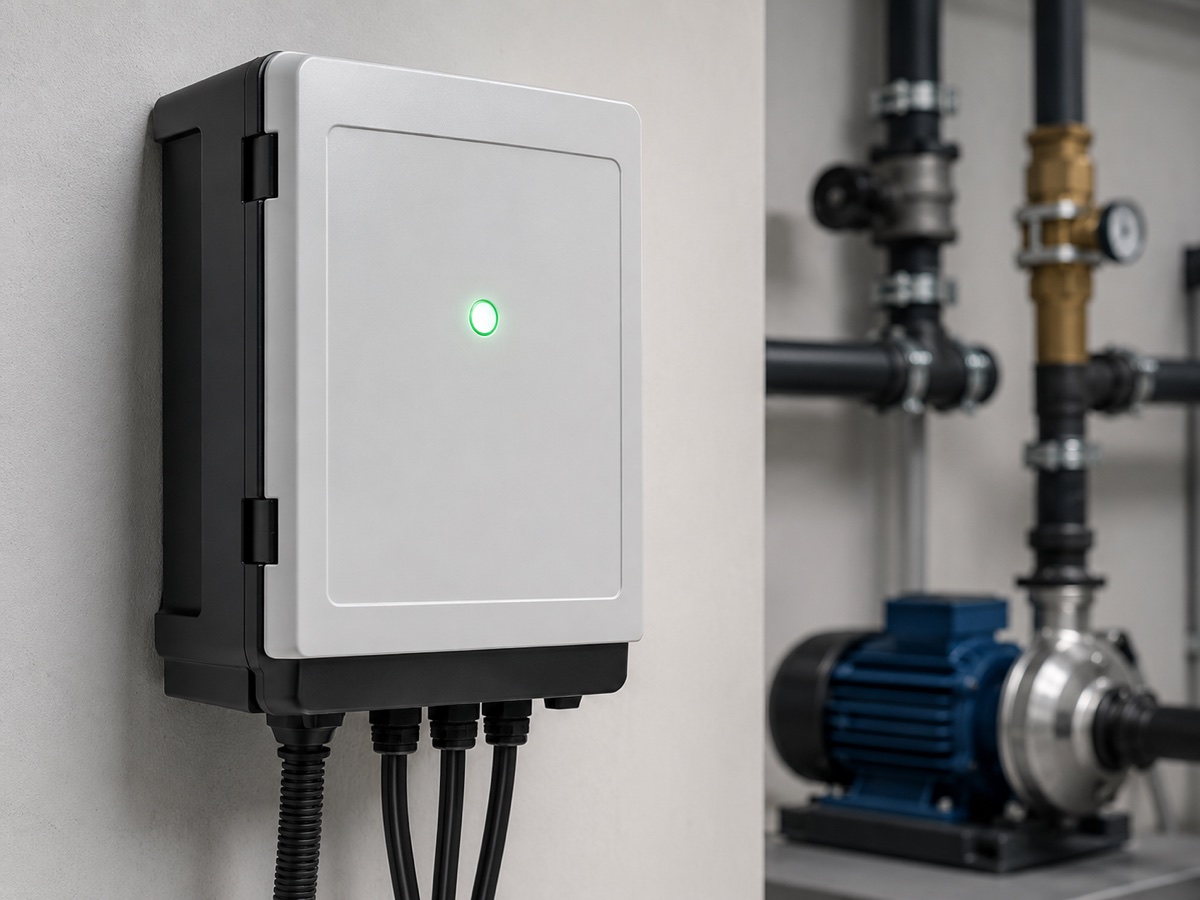
Almost every mid-sized Indian housing society employs someone — a watchman, a dedicated pump operator, or a rotating duty among staff — whose real job includes walking to the terrace multiple times a day to check tank levels and switch motors on and off. It’s rarely written down as a line item, but it’s a real, recurring cost. Here’s what it actually adds up to, and what replacing it with automation costs instead.
What does a manual pump operator cost?
For a society with 2-10 pumps and multiple tanks, dedicated or partial pump-operator labour typically runs ₹15,000-25,000 per month — sometimes bundled into a watchman’s salary, sometimes a separate hire. For larger societies (30+ towers), this scales to multiple staff or shifts, which can mean ₹40,000-45,000/month or more once you account for 3 operators covering shifts across a large campus.
That number doesn’t include the hidden costs:
- Overflow waste — a motor left running 20 minutes too long, multiple times a week, adds up in both water and electricity over a year.
- Motor burnout — dry-running (motor left on with an empty tank/sump) is one of the top causes of premature pump failure. A replacement motor plus labour is a real, if irregular, cost.
- 2am callouts — when a tank runs dry overnight, someone has to be woken up to fix it, or residents go without water until morning.
- No audit trail — when a resident complains about water supply, there’s usually no data to show what actually happened, just a manual logbook (if one exists at all).
What does automated monitoring cost instead?
Subscription-based tank and motor automation is typically priced per sensor/controller unit (“node”) per month, with the provider owning and maintaining the hardware — no upfront capital cost, no separate AMC. For a typical society, this commonly lands at less than half the cost of a dedicated pump operator, while running 24/7 rather than during a single shift.
The rough math for an 8-10 tower society: a pump operator at ₹15,000-25,000/month vs. an automated system covering the same towers at a fraction of that — the exact number depends on how many tanks and motors need nodes, but the society-vs-automation gap holds even before counting the water/electricity savings from eliminating overflow and reducing motor runtime.
Automation doesn’t replace people entirely — it replaces the routine
This isn’t about eliminating staff. Most societies still want someone accountable for the building’s water system. What automation removes is the manual routine — the multiple daily terrace walks, the guesswork about tank levels, the risk of forgetting to switch a motor off. Staff time shifts from “checking tanks” to “acting on alerts,” which is a smaller and more predictable time commitment.
What about the RWA secretary’s time?
There’s a second, less visible cost: the RWA secretary or committee member who gets the 2am call when something goes wrong, or who has to explain to residents why Block C had no water for six hours. A live dashboard that shows every tank’s status — and sends an alert before a tank runs dry rather than after — turns this from a reactive fire-drill into something the secretary can point to at the next committee meeting with actual usage and savings data.
How to compare quotes
When evaluating automated water management for a society, ask for:
- Per-node monthly price, not just a headline number — confirm exactly how many sensors and motor controllers your site needs.
- What’s included — installation, firmware updates, hardware repairs/replacement should all be bundled into the subscription, not billed separately as an AMC.
- Minimum contract length — reasonable providers offer short initial terms (3 months) for standard societies.
- Who installs it — your existing electrician or maintenance staff should be able to do it after a short training session, not require a specialist visit every time.
Frequently asked questions
Does automation eliminate the need for a pump operator entirely?
Usually not entirely, but it eliminates the manual monitoring routine that consumes most of that role’s time — many societies redeploy that staff time elsewhere rather than removing the position.
How fast does the cost pay back?
For most societies already paying for dedicated pump-operator labour, the monthly subscription cost is lower than the labour it replaces from month one — there’s no multi-year payback period to wait out.
Does this require capital approval from the managing committee?
Subscription-based models (where the provider owns the hardware) typically don’t require capital expenditure approval — it’s an operating expense, similar to the pump operator’s salary it replaces.
